Introduction
Cooking often involves more than following a recipe from beginning to end. Measurements are an important part of the process, and a small conversion mistake can change the texture, consistency, or quantity of a finished dish. This becomes particularly noticeable when recipes use different measurement systems or when a cook needs to quickly convert teaspoons to tablespoons, cups to fluid measurements, or other common kitchen units.
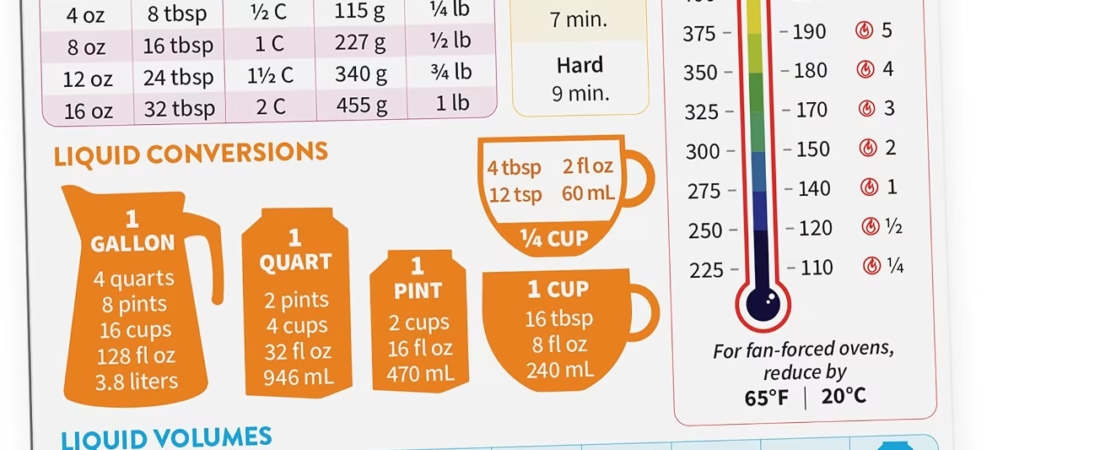
A Kitchen Conversion Chart Magnet provides a simple solution to this everyday problem by keeping frequently used measurement references within easy reach. Instead of searching through a cookbook, checking a phone, or trying to remember conversions from memory, a physical kitchen chart can serve as a quick reference while ingredients are being prepared.
The product discussed here is a 6-inch by 8-inch magnetic kitchen measurement conversion chart, described as a waterproof kitchen accessory for cooking and baking. Its compact format is intended to make common conversions accessible while taking up relatively little space.
A kitchen conversion chart can be particularly useful for bakers, home cooks, students learning kitchen skills, and anyone who regularly works with recipes that use different measurements. It can also serve as a practical kitchen gift because it is an accessory rather than another appliance or piece of cookware.
However, a conversion chart should be understood as a reference tool rather than a substitute for accurate measuring equipment. When precision matters, particularly in baking, the chart should be used alongside appropriate measuring cups, spoons, or a kitchen scale.
This guide explores the role of a magnetic kitchen conversion chart, its main characteristics, practical applications, advantages and limitations, and the differences between a physical conversion chart and other ways of finding measurement information.
What Is a Kitchen Conversion Chart?
A kitchen conversion chart is a reference that lists relationships between commonly used cooking and baking measurements.
Recipes may use measurements such as:
- Teaspoons
- Tablespoons
- Cups
- Fluid ounces
- Pints
- Quarts
- Gallons
- Other common kitchen units
A conversion chart organizes these relationships in a way that allows cooks to quickly determine an equivalent measurement.
For example, a recipe may call for a certain number of tablespoons while the cook prefers to measure using a cup. Rather than performing the conversion manually, the user can consult the chart.
The magnetic format adds another practical feature.
Instead of keeping the chart inside a cookbook drawer, it can be placed on a suitable magnetic surface in or around the kitchen.
This makes the information visible when it is needed.
Key Features
6-Inch by 8-Inch Format
The chart measures approximately 6 inches by 8 inches.
This size provides enough space for multiple measurement references while remaining relatively compact.
A larger chart might be easier to read from a distance, but it would also require more wall or refrigerator space.
A compact chart can work well in kitchens where countertop and wall space are limited.
Magnetic Design
The chart is designed as a magnetic kitchen accessory.
A magnetic backing allows it to attach to suitable metal surfaces without requiring permanent mounting hardware.
This can make it convenient to place on a refrigerator, magnetic kitchen board, or another compatible surface.
The location can also be changed if the user reorganizes the kitchen.
Cooking and Baking Reference
The chart is designed for both cooking and baking applications.
Although recipes vary considerably, many use the same fundamental measurement relationships.
Having a shared reference for both types of food preparation can make the chart more versatile.
Waterproof Construction
The product is described as waterproof.
A waterproof or water-resistant surface can be particularly useful in a kitchen because cooking areas are exposed to moisture, splashes, steam, and occasional spills.
This characteristic can make routine cleaning easier than with an ordinary paper conversion chart.
The exact cleaning method should still follow the manufacturer’s recommendations.
Compact Kitchen Accessory
The chart does not require electricity, batteries, software, or a complicated installation process.
Its usefulness comes from being a readily accessible physical reference.
That simplicity is part of its appeal.
Gift-Oriented Kitchen Design
A measurement chart can also work as a practical kitchen gift.
It does not depend on the recipient already owning a particular appliance, making it broadly relevant to people who cook or bake.
Why Measurement Conversions Matter in Cooking
Measurement conversions may seem straightforward, but they can become important when recipes use unfamiliar units.
Different Recipe Sources Use Different Measurements
Recipes from different countries, cookbooks, websites, and food creators may use different measurement systems.
A recipe might use cups and tablespoons, while another may use milliliters and grams.
A conversion reference can make it easier to understand the relationship between common units.
Baking Requires Consistency
Baking is particularly sensitive to ingredient proportions.
Flour, sugar, liquids, fats, and leavening ingredients interact in specific ways.
An incorrect conversion can change the balance of a recipe.
A chart can help reduce simple conversion errors, although accurate measuring technique remains essential.
Scaling Recipes
People often need to make more or less food than the original recipe produces.
For example, a recipe designed for four servings may need to be adjusted for two or eight.
While scaling requires multiplication or division in addition to unit conversion, a measurement chart can help simplify the process when the resulting quantity becomes awkward to measure.
Everyday Convenience
Even experienced cooks may not remember every measurement relationship.
A physical chart provides a quick reminder without requiring mental calculations.
How It Can Be Used
During Baking
Baking is one of the most obvious applications.
A cook can keep the conversion chart visible while measuring ingredients for cakes, cookies, breads, muffins, pastries, and other baked goods.
If a recipe uses tablespoons but the available measuring tool is a cup or another unit, the chart can provide a quick reference.
Following International Recipes
Recipes from different regions may use different measurement conventions.
A kitchen conversion chart can help users interpret common measurements without constantly searching online.
However, users should pay attention to whether a recipe uses volume or weight measurements.
A cup of flour and a specific weight of flour are not necessarily interchangeable simply by using a liquid-volume conversion.
Converting Liquid Measurements
Liquid ingredients such as milk, water, oil, broth, and sauces are often measured using volume units.
A conversion chart can help users move between common volume measurements.
A suitable liquid measuring cup should still be used for accuracy.
Adjusting Recipe Quantities
When increasing or reducing a recipe, measurement conversions can become more complicated.
For example, doubling a recipe may produce a quantity that is easier to express in another unit.
A chart can help the cook convert the resulting measurement into something practical.
Teaching Children Basic Kitchen Skills
A kitchen conversion chart can also be a simple educational tool.
Parents, teachers, or cooking instructors can use it when introducing basic kitchen measurement concepts.
Children can learn how teaspoons, tablespoons, cups, and larger units relate to one another.
The physical chart provides a visual reference rather than requiring them to memorize every relationship immediately.
Cooking With Students
Students learning to cook often need quick access to basic information.
A conversion chart can be particularly convenient in shared kitchens, dormitory kitchens, or first apartments.
Meal Preparation
Meal prep frequently involves scaling recipes.
Someone preparing multiple portions may need to convert or adjust quantities repeatedly.
A chart can serve as a convenient reference during the preparation process.
Keeping the Chart Near the Refrigerator
The refrigerator is a natural location for a magnetic kitchen reference.
If the refrigerator surface is compatible with magnets, the chart can remain visible and accessible.
However, users should avoid locations where the chart may be exposed to excessive heat, steam, or direct splashing.
Understanding Common Kitchen Measurements
A useful conversion chart can help users become more familiar with the relationships between common units.
Teaspoons
Teaspoons are commonly used for relatively small quantities.
They appear frequently in recipes for spices, extracts, baking powder, salt, and other ingredients.
Because small measurement errors can matter in some recipes, using an appropriate measuring spoon remains important.
Tablespoons
Tablespoons represent a larger volume than teaspoons and are frequently used for sauces, oils, liquids, and other ingredients.
They are also commonly used in baking recipes.
Cups
Cups are common in many North American recipes.
They are particularly useful for measuring larger quantities of both dry and liquid ingredients.
However, the measuring technique differs between dry and liquid ingredients.
Fluid Ounces
Fluid ounces are used for volume rather than weight.
This distinction is important.
A fluid ounce measures volume, while an ounce on a kitchen scale generally refers to weight.
The two should not be treated as interchangeable.
Pints, Quarts, and Gallons
These larger volume units may appear in recipes involving beverages, soups, stocks, or large quantities of liquid.
A conversion chart can help users understand their relationship to smaller measurements.
Volume vs. Weight: An Important Distinction
One of the most important concepts when using kitchen conversion information is understanding the difference between volume and weight.
Volume Measurements
Volume describes how much physical space an ingredient occupies.
Common volume units include:
- Teaspoons
- Tablespoons
- Cups
- Fluid ounces
- Milliliters
- Liters
Weight Measurements
Weight measurements are commonly expressed in:
- Grams
- Kilograms
- Ounces
- Pounds
A kitchen scale measures weight.
Why the Difference Matters
A cup of one ingredient does not necessarily weigh the same as a cup of another.
For example, a cup of flour and a cup of sugar have different weights.
Therefore, a conversion chart for volume cannot automatically convert a cup of any ingredient into a universal weight.
When a recipe provides weight measurements, a kitchen scale is usually the appropriate tool.
Practical Benefits
Quick Access to Information
The biggest practical advantage is accessibility.
Instead of searching for a conversion every time a question arises, the user can simply look at the chart.
No Phone Required
A physical reference means the user does not have to handle a smartphone with messy hands.
This can be particularly convenient while kneading dough, mixing batter, or handling raw ingredients.
Easy to Keep Visible
The magnetic format allows the chart to remain in a visible location.
This can make it easier to develop familiarity with common conversions.
Useful for Beginners
New cooks do not need to memorize every measurement relationship.
A chart can provide confidence while they develop their kitchen skills.
Space Efficient
At 6 by 8 inches, the chart is relatively compact.
It can provide useful information without requiring a large wall-mounted reference board.
Reusable Reference
Unlike disposable recipe notes, a durable kitchen chart can remain available for repeated use.
Who It May Be Suitable For
Home Bakers
People who bake regularly may benefit from having measurement information close to their preparation area.
Beginner Cooks
Beginners can use a chart to learn basic measurement relationships while following recipes.
Experienced Cooks
Experienced cooks may also find it useful as a quick reminder.
Cooking experience does not necessarily mean remembering every conversion.
Students
Students living away from home may appreciate simple kitchen references when developing cooking skills.
Families
A household can keep the chart in a shared kitchen so that different family members can access the same information.
Teachers and Cooking Instructors
A physical conversion chart can be useful as a visual teaching aid.
Gift Recipients
Because measurement conversions apply broadly to cooking and baking, this type of kitchen accessory can work as a practical gift for someone who enjoys preparing food.
Important Things to Consider
Verify the Conversion When Precision Matters
Although a kitchen chart can provide useful reference information, important recipes may require additional verification.
This is especially relevant for baking, where precise proportions can affect results.
Understand the Measurement System
Different countries use different measurement conventions.
A recipe may use U.S. customary units, metric measurements, or another system.
Make sure the chart and recipe are using compatible definitions.
Cups Can Mean Different Things
The word “cup” can refer to different standards depending on the recipe’s origin.
A measuring cup designed for one measurement system may not correspond exactly to another.
When following an international recipe, determine which measurement convention is being used.
Do Not Confuse Fluid Ounces With Ounces by Weight
This is a common source of confusion.
Fluid ounces refer to volume.
Ounces on a kitchen scale refer to weight.
A conversion between the two depends on the ingredient’s density and cannot be treated as a universal fixed relationship.
Dry and Liquid Measuring Techniques Differ
Liquid measuring cups are typically designed to measure volume accurately for liquids.
Dry measuring cups are commonly filled and leveled for dry ingredients.
Using the appropriate measuring tool can improve accuracy.
The Magnetic Surface Must Be Compatible
Not every surface attracts magnets strongly.
Some refrigerator doors and appliance panels may contain materials that do not provide enough magnetic attraction.
Check the intended surface before relying on it for storage.
Avoid Excessive Moisture
Although the product is described as waterproof, excessive exposure to heat, steam, or harsh cleaning products may still affect printed materials over time.
Follow the manufacturer’s care instructions.
Keep It Away From Direct Heat
A refrigerator door or cabinet side can be suitable.
The area directly beside an oven, stovetop, or other hot surface may not be appropriate.
Magnetic Conversion Chart vs. Paper Reference
A paper conversion chart is a traditional solution.
It can be printed at home or included in cookbooks and recipe materials.
Paper Chart Advantages
Paper is inexpensive and can be replaced easily.
It can also be stored inside a recipe binder.
Magnetic Chart Advantages
A magnetic chart can remain visible and accessible.
It does not require permanent adhesive or wall mounting if placed on a compatible metal surface.
The described waterproof construction may also make it more suitable for a kitchen environment than ordinary paper.
Magnetic Conversion Chart vs. Smartphone Apps
Smartphones provide access to many conversion calculators.
A user can enter a measurement and receive an answer immediately.
Smartphone Advantages
Digital tools can perform complex conversions and handle unusual quantities.
They can also provide information beyond cooking measurements.
Physical Chart Advantages
A physical chart is quick to glance at and does not require unlocking a phone, opening an app, or touching a screen with food-covered hands.
It is especially convenient for frequently used basic conversions.
Using Both
There is no need to choose one method exclusively.
A physical chart can handle common conversions while a smartphone calculator can be used for unusual or more complex calculations.
Magnetic Conversion Chart vs. Kitchen Scale
A conversion chart and a kitchen scale serve completely different purposes.
A chart explains relationships between measurement units.
A scale measures the actual weight of ingredients.
For baking recipes that provide ingredients in grams, a kitchen scale is generally more appropriate than converting everything into cups.
The two tools can complement each other rather than replace one another.
How to Use a Conversion Chart More Effectively
Keep It Near the Preparation Area
The closer the chart is to the area where ingredients are measured, the more useful it becomes.
A refrigerator, pantry door with a magnetic surface, or another convenient location can work.
Learn the Most Common Conversions
Instead of checking every measurement, use the chart as a learning aid.
With repeated use, common relationships become easier to remember.
Combine It With Proper Measuring Tools
A chart provides information, while measuring cups, spoons, and scales provide the actual measurements.
Using both together produces a more reliable workflow.
Check Recipe Context
Before converting a measurement, determine whether the recipe refers to volume or weight.
This prevents incorrect conversions.
Keep International Recipes Organized
When using recipes from different countries, note which measurement system each recipe uses.
This can prevent confusion when switching between metric and customary units.
Cooking and Baking Situations Where a Chart Can Help
Cookies
Cookie recipes frequently use cups, tablespoons, and teaspoons.
A conversion reference can help when adjusting quantities.
Cakes
Cake recipes often involve several ingredients measured in different units.
A chart can be useful when translating between measurements.
Bread
Bread recipes may use both volume and weight measurements.
For serious bread baking, weight measurements can provide greater consistency, but a conversion chart can still help interpret volume-based recipes.
Sauces
Sauces often use tablespoons, teaspoons, cups, and fluid measurements.
A chart can make adjustments easier.
Soups
Large-batch soup recipes may use cups, quarts, or other volume measurements.
A conversion chart can help when scaling the recipe.
Drinks
Recipes for beverages, syrups, and mixed drinks can also involve multiple volume units.
The chart can serve as a quick reference for these measurements.
Frequently Asked Questions
What is a kitchen conversion chart?
A kitchen conversion chart is a reference tool that shows relationships between common cooking and baking measurement units.
What size is this kitchen conversion chart?
The product is described as measuring approximately 6 inches by 8 inches.
Is the chart magnetic?
Yes. It is designed as a magnetic kitchen chart that can be placed on a compatible metal surface.
Where can a magnetic kitchen conversion chart be placed?
A refrigerator, magnetic kitchen board, or another suitable metal surface can be used, provided the surface securely holds the magnet.
Is the chart waterproof?
The product is described as waterproof. Users should still follow the manufacturer’s cleaning and care recommendations.
Can it be used for baking?
Yes. Measurement conversions are particularly useful when following baking recipes that use different units.
Is a conversion chart useful for beginner cooks?
Yes. Beginners can use it as a reference while learning common kitchen measurements.
Can experienced cooks benefit from one?
Yes. Even experienced cooks may encounter unfamiliar measurements or need to scale a recipe.
Does a conversion chart replace measuring cups?
No. The chart provides information about measurement relationships, while measuring cups are used to measure ingredients.
Does it replace a kitchen scale?
No. A kitchen scale measures weight, while a conversion chart primarily helps interpret measurement relationships.
Are fluid ounces the same as ounces by weight?
No. Fluid ounces measure volume, while ounces by weight measure mass. They should not be treated as interchangeable without considering the ingredient.
Can I convert cups to grams using the chart?
A volume-to-weight conversion depends on the ingredient. One cup of flour does not weigh the same as one cup of sugar, for example. A general volume conversion chart should not be treated as a universal grams-per-cup table.
Why are conversions useful in baking?
Baking depends heavily on ingredient proportions. Conversions can help users interpret recipes correctly and adjust measurements when necessary.
Can the chart help with scaling recipes?
Yes. It can help with measurement relationships when a recipe is increased or reduced, although scaling still requires the user to perform the appropriate multiplication or division.
Can children use a kitchen conversion chart?
A conversion chart can serve as a visual educational tool when teaching children basic kitchen measurement concepts. Adult supervision is appropriate for cooking activities involving heat or sharp tools.
Can I put the chart near the stove?
It is better to choose a location away from direct heat, steam, and splashing. A refrigerator or another cooler magnetic surface may be more appropriate.
Will the magnet work on every refrigerator?
Not necessarily. Refrigerator materials vary, and some surfaces may not hold magnets strongly.
How should I clean the chart?
Follow the manufacturer’s care instructions. Since it is intended for kitchen use, the waterproof design may make routine surface cleaning easier, but harsh chemicals or abrasive materials should not be assumed to be suitable.
Is a physical chart better than a conversion app?
They serve different purposes. A physical chart is convenient for quick reference, while an app can perform more complex or unusual calculations.
Can the chart be used with metric recipes?
It depends on which conversions are included on the specific chart. Users should check that the units required by their recipes are represented.
What should I consider when using a kitchen conversion chart?
Pay attention to whether the recipe uses volume or weight, which measurement system it follows, and whether the conversion shown applies to the particular ingredient or unit being measured.
Conclusion
The Kitchen Conversion Chart Magnet is a simple reference accessory designed to make common cooking and baking measurements easier to understand.
Its 6-by-8-inch format provides a compact way to keep measurement information close to the cooking area, while the magnetic design allows it to be placed on a suitable refrigerator or other metal surface. The described waterproof construction is also relevant to the realities of kitchen use, where splashes and moisture are common.
For beginners, the chart can make unfamiliar measurements less intimidating. For experienced cooks and bakers, it can serve as a convenient reminder when working with recipes that use different units or when adjusting quantities.
Its usefulness is greatest when combined with proper measuring equipment. A conversion chart tells you how units relate to one another, but it does not physically measure an ingredient. Measuring cups and spoons remain important for volume, while a kitchen scale is generally the better tool when a recipe specifies weight.
It is also important to understand the difference between volume and weight. Fluid ounces and ounces by weight are not the same thing, and a cup of one ingredient cannot automatically be converted into the same weight as a cup of another ingredient.
Compared with a paper reference, a magnetic chart can remain visible and accessible in the kitchen. Compared with a smartphone app, it offers quick physical access without requiring a device or screen. Compared with a kitchen scale, it serves a completely different purpose.
For home cooks, bakers, students, families, and anyone who regularly works with recipes using different measurements, a compact kitchen conversion chart can be a practical addition to the cooking area.